Audio Visual & Collaboration

The hybrid office model is fundamentally reshaping how businesses design workspaces, deploy technology, and support distributed teams in the modern workplace.

The Foundation of Hybrid Workplace Infrastructure
The shift to hybrid work isn't just a temporary accommodation—it's a fundamental restructuring of how businesses operate. For MSPs and IT resellers, this transition represents both a challenge and a significant revenue opportunity. Your clients are grappling with a reality where meeting spaces sit unused while employees struggle to find available desks, where conference rooms are booked but half-empty, and where technology investments aren't delivering the expected return.
The problem isn't a lack of technology. It's a lack of intelligent infrastructure that connects physical space with digital workflows. Traditional office management relied on assumptions: desks were always available, meeting rooms were scheduled manually, and space planning happened once a year during budget reviews. Hybrid work destroys these assumptions. When 40-60% of your workforce rotates through the office on unpredictable schedules, you can't manage space the way you used to.
This is where smart workplace management solutions like Skedway become essential infrastructure rather than nice-to-have additions. Skedway's Meeting Room Arc and Desk Manager Avail address the core challenge of hybrid office evolution: making physical space as flexible and responsive as digital tools. For resellers, this represents a greenfield opportunity. Your clients have invested heavily in collaboration platforms and remote connectivity, but most haven't addressed the physical workspace management gap.
The foundation of successful hybrid infrastructure rests on three pillars: visibility, flexibility, and integration. Employees need real-time visibility into available resources—not just conference rooms, but individual desks, collaboration spaces, and even parking. The infrastructure must be flexible enough to accommodate constantly shifting schedules and team configurations. And critically, these systems must integrate with existing calendar, security, and workplace tools rather than creating yet another standalone platform.
Consider the typical scenario your clients face: A manager schedules an in-office day for their team, only to discover there aren't enough desks in their usual area. A client visits for an important meeting, but the reserved conference room's video conferencing equipment isn't compatible with their presentation format. Remote employees struggle to find available meeting rooms when they do come to the office, leading to frustration and decreased collaboration effectiveness. These aren't edge cases—they're daily realities that erode the value proposition of maintaining physical office space.
For resellers positioning hybrid workplace solutions, the conversation starts with quantifying waste. Most organizations can't accurately answer basic questions: What percentage of our meeting rooms are actually utilized? How many desks remain empty on average? Are we paying for square footage that delivers no value? Solutions like Desk Manager Avail provide the data layer that makes these questions answerable—and the management layer that makes them solvable.
Technology Solutions That Enable Seamless Collaboration
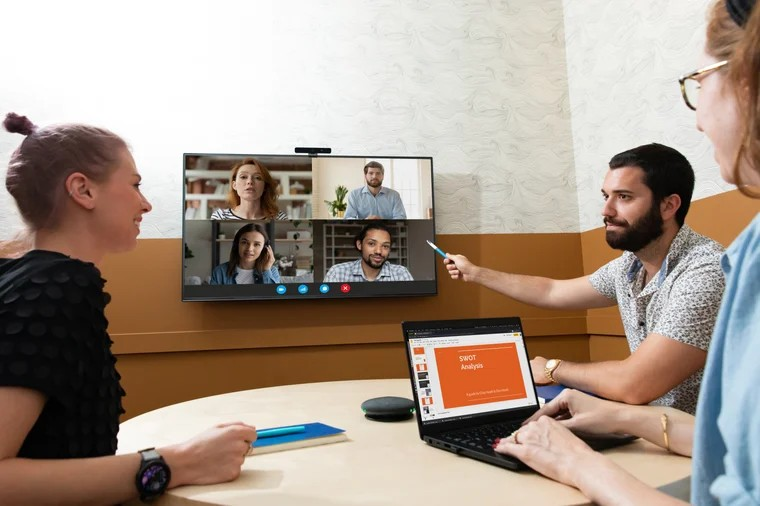
The evolution of the hybrid office hinges on eliminating the collaboration gap between in-office and remote participants. This isn't about simply adding more video conferencing equipment—it's about creating technology ecosystems where location becomes invisible to productivity. For IT resellers and MSPs, understanding this distinction separates commodity providers from strategic partners.
Yealink communication solutions exemplify the shift from traditional conferencing to hybrid-optimized collaboration. The difference lies in intelligent features designed specifically for mixed-attendance scenarios: automatic framing that adjusts to the number of in-room participants, noise cancellation that isolates voices from office ambient sound, and acoustic fence technology that prevents echo in open workspace environments. These aren't marketing features—they're solutions to real problems your clients experience in every hybrid meeting.
The meeting room technology stack in a hybrid environment requires more sophistication than previous generations. At the foundation, you need enterprise-grade displays that support multiple input sources and wireless presentation. Capsul displays offer the visual clarity and connectivity options that modern meeting spaces demand, with features like USB-C connectivity that eliminate the cable chaos that plagues traditional conference rooms. When a remote employee shares their screen, everyone in the room needs to see details clearly—poor display quality creates a two-tiered meeting experience that defeats the purpose of collaboration.
Meeting Room Arc by Skedway addresses a critical but often overlooked challenge: room utilization and availability management. The technology layer is only effective if employees can actually access it when needed. Meeting Room Arc provides intelligent scheduling that prevents ghost meetings (rooms booked but unused), enables hot-desking for collaboration spaces, and integrates with existing calendar systems to provide real-time availability. For resellers, this creates a consultative selling opportunity—you're not just providing hardware, you're architecting workspace efficiency.
The peripheral ecosystem matters more in hybrid environments than traditional offices. Capsul IT peripherals address the reality that employees need consistent experiences whether they're working from a company desk, a home office, or a hotel room. Standardizing on quality peripherals—keyboards and mice—reduces support calls and ensures that technology doesn't become a barrier to productivity. For MSPs managing multiple client environments, standardization also simplifies your own support model and inventory management.
Dynabook laptops represent the mobile foundation of hybrid work, but their role extends beyond individual productivity. In a hybrid model, laptops must seamlessly transition between environments, maintain security across networks, and integrate with room systems for wireless presentation. The specification conversation shifts from processor speed to connectivity options, battery life for untethered meetings, and compatibility with both cloud-based and on-premise systems. Your clients need devices that work everywhere their employees work—and that your team can support efficiently.
The real opportunity for resellers lies in solution integration rather than product sales. A properly architected hybrid collaboration environment includes room systems, personal devices, connectivity infrastructure, and management software working as a unified ecosystem. This requires understanding not just individual products but how they interact, where integration challenges occur, and how to configure systems for specific client workflows. This expertise—the ability to design rather than simply supply—is where margin and client loyalty are built.
Security and Connectivity in Distributed Work Environments
Hybrid work fundamentally changes the security perimeter. When employees access company resources from office desks, home networks, coffee shops, and client locations, traditional castle-and-moat security models fail. For MSPs and IT resellers, this complexity creates both risk and opportunity—clients need guidance navigating security requirements that span physical and digital domains.
The security conversation must address three distinct challenges: device security, network security, and physical security. Each requires different solutions, but all must work together cohesively. Device security starts with endpoint management—ensuring that laptops, tablets, and smartphones maintain appropriate security postures regardless of location. This includes encryption, patch management, and access controls that follow the device rather than depending on network location.
Network connectivity in hybrid environments can't rely on VPN solutions designed for occasional remote access. Employees now work from distributed locations as their primary mode—the office is just another location, not the default. This requires rethinking connectivity architecture: zero-trust frameworks that verify every access request, cloud-based security that doesn't bottleneck through corporate data centers, and seamless authentication that doesn't create friction for legitimate users.
Physical security takes on new dimensions in hybrid offices. Desk Manager Avail provides not just space management but also access tracking—understanding who is in the office, when, and where they're working. This isn't surveillance; it's essential for emergency planning, space utilization analysis, and ensuring that physical security measures match actual usage patterns. When 30% of desks are occupied on a given day, does it make sense to secure and climate-control entire floors?
For resellers, security solutions create recurring revenue opportunities. Unlike one-time hardware purchases, security requires ongoing management, updates, and monitoring. MSPs can position hybrid security as a managed service that evolves with the threat landscape and the client's changing work patterns. This includes regular security assessments, policy updates, and technology refreshes that keep pace with both threats and business needs.
The connectivity discussion extends beyond security to performance and reliability. Video conferencing—now a primary collaboration tool rather than occasional convenience—demands consistently high bandwidth and low latency. When employees work from diverse locations, you can't assume connectivity quality. Solutions must include network monitoring, quality of service configurations that prioritize real-time communication, and fallback options when primary connections fail.
Compliance requirements add another layer of complexity to hybrid security. Industries with regulatory obligations—healthcare, finance, legal services—must ensure that data protection and privacy measures apply regardless of where employees work. This requires encryption for data at rest and in transit, access logging for audit purposes, and physical security measures for home offices handling sensitive information. For resellers serving regulated industries, expertise in compliance requirements becomes a significant differentiator.
Optimizing Document Workflows Across Physical and Digital Spaces
The hybrid office challenges traditional assumptions about document workflows. When some team members work in the office while others work remotely, documents can't exist primarily in physical form—but they also can't be purely digital when physical signatures, official copies, or paper-based processes remain necessary. This duality creates workflow friction that impacts productivity and client experience.
Print and copy infrastructure requires rethinking in hybrid environments. The traditional model—dedicated printers on every floor, individual desktop printers for executives, copy rooms as collaboration spaces—doesn't align with variable office occupancy. Organizations need flexible print solutions that accommodate both reduced office presence and the reality that certain documents still require physical copies. This creates opportunities for resellers to position managed print services that scale with actual usage rather than assumed capacity.
Hyperion compatible supplies represent a practical approach to managing print costs in unpredictable hybrid environments. When print volumes fluctuate significantly based on office occupancy rates, compatible supplies provide cost flexibility without sacrificing quality. For IT resellers advising clients on hybrid transition strategies, the conversation includes rightsizing print infrastructure, implementing print tracking to understand actual usage patterns, and optimizing supply costs to match the new reality of reduced but still essential printing needs.
Document scanning and digitization become more critical when physical document sharing is complicated by distributed teams. Employees working remotely can't easily access paper files, signed contracts, or physical correspondence. This drives demand for reliable scanning solutions that integrate with document management systems, cloud storage, and collaboration platforms. The technology requirement isn't just scanning capability—it's automated workflows that route scanned documents to appropriate systems without manual intervention.
The workflow optimization opportunity extends beyond simply digitizing documents. Hybrid work enables rethinking business processes that previously assumed physical proximity. Contract reviews, approval workflows, invoice processing, and client onboarding can be redesigned to eliminate location dependencies. For MSPs with clients in professional services, healthcare, legal, or financial sectors, documenting current workflows and identifying digitization opportunities creates immediate value and positions you for longer-term process improvement engagements.
Cloud-based document management systems become infrastructure rather than convenience in hybrid offices. When employees need to access, edit, and share documents from multiple locations and devices, centralized cloud storage with version control and access management becomes essential. The reseller conversation shifts from selling storage to architecting information management: how documents are organized, who has access, how long versions are retained, and how information is secured across the document lifecycle.
For resellers, document workflow optimization creates cross-selling opportunities that span hardware, software, and services. A comprehensive solution might include multifunction devices optimized for hybrid environments, compatible supplies to manage costs, scanning software with intelligent routing, cloud storage integration, and managed services to monitor, maintain, and optimize the entire ecosystem. This integrated approach transforms you from a supplies vendor to a workflow efficiency partner.
Measuring Success and Future-Proofing Your Hybrid Office Strategy
The transition to hybrid work represents a significant investment for your clients—in technology, in process changes, and in cultural adaptation. To justify continued investment and demonstrate ROI, organizations need metrics that quantify hybrid workplace effectiveness. For resellers and MSPs, helping clients establish and track these metrics positions you as a strategic advisor rather than a technology vendor.
Space utilization metrics provide the foundation for measuring hybrid office success. Solutions like Desk Manager Avail generate data on actual desk and meeting room usage, revealing patterns that inform real estate decisions, renovation priorities, and technology deployment. When data shows that certain floors are consistently underutilized while others are overcrowded, organizations can make informed decisions about space reallocation, hoteling policies, or even real estate footprint reduction. These insights translate directly to cost savings that justify technology investments.
Collaboration effectiveness metrics measure whether hybrid technology investments actually improve teamwork. This includes meeting participation rates, video conferencing quality scores, document sharing frequency, and user satisfaction surveys. Meeting Room Arc provides data on room utilization, booking patterns, and no-show rates—revealing whether meeting space investments are delivering value or representing wasted capacity. For MSPs managing client environments, these metrics also inform your own service delivery, highlighting support issues and optimization opportunities.
Employee experience metrics bridge the gap between technology deployment and business outcomes. Hybrid work succeeds when employees feel equally productive and connected regardless of location. This requires measuring experience factors: how easily can employees find and book workspace when they come to the office? Do they experience technical difficulties in hybrid meetings? Can they access necessary documents and systems from any location? Regular pulse surveys combined with usage analytics create a complete picture of hybrid experience quality.
Technology utilization metrics justify specific investments and inform future purchasing decisions. When you deploy Yealink communication solutions, Innocn displays, or Capsul peripherals, usage data reveals which investments deliver value and which remain underutilized. This data informs refresh cycles, expansion decisions, and reallocation of resources to higher-impact areas. For resellers, providing clients with utilization reporting creates transparency that builds trust and positions you for future opportunities.
Cost metrics demonstrate the financial impact of hybrid workplace strategies. This includes real estate cost per employee, technology cost per user, support costs for distributed versus centralized work, and productivity metrics that quantify business outcomes. The goal isn't just cost reduction—it's cost optimization that maintains or improves outcomes while eliminating waste. Hyperion compatible supplies, for example, reduce print costs without sacrificing quality, creating measurable savings that support the broader hybrid investment case.
Future-proofing hybrid office strategies requires flexibility in both technology choices and deployment approaches. The hybrid model will continue evolving as employee expectations, business requirements, and available technology advance. Resellers who position modular, scalable solutions rather than fixed implementations create client relationships that extend beyond initial deployments. This means specifying systems with upgrade paths, using standards-based technologies that integrate with emerging tools, and maintaining relationships that anticipate rather than react to changing needs.
The measurement framework you help clients establish becomes the foundation for ongoing engagement. Regular quarterly reviews of space utilization, collaboration effectiveness, and cost metrics create natural touchpoints for discussing optimization opportunities, technology updates, and strategic adjustments. These conversations shift from 'Do you need to buy anything?' to 'Here's what the data shows about your hybrid workplace, and here's how we can improve it.' That shift—from vendor to advisor—is where reseller margin and client loyalty are built.
For MSPs and IT resellers, the hybrid office evolution represents a multi-year opportunity to partner with clients on an ongoing transformation rather than a one-time technology refresh. Organizations aren't returning to 2019 workplace models—they're building something fundamentally different. Your expertise in architecting, deploying, and optimizing the technology infrastructure that enables this transformation positions you for sustained growth as hybrid work continues maturing from experiment to standard operating model.
Image Star partners with MSPs and IT resellers to support this journey with the technology ecosystem, distribution strength, and channel expertise required to deliver measurable hybrid workplace outcomes. If you would like to learn more about how our portfolio and programs can help you build and execute a data-driven hybrid strategy for your clients, connect with your Image Star account executive or reach out to our team to start the conversation.