
Print & Imaging
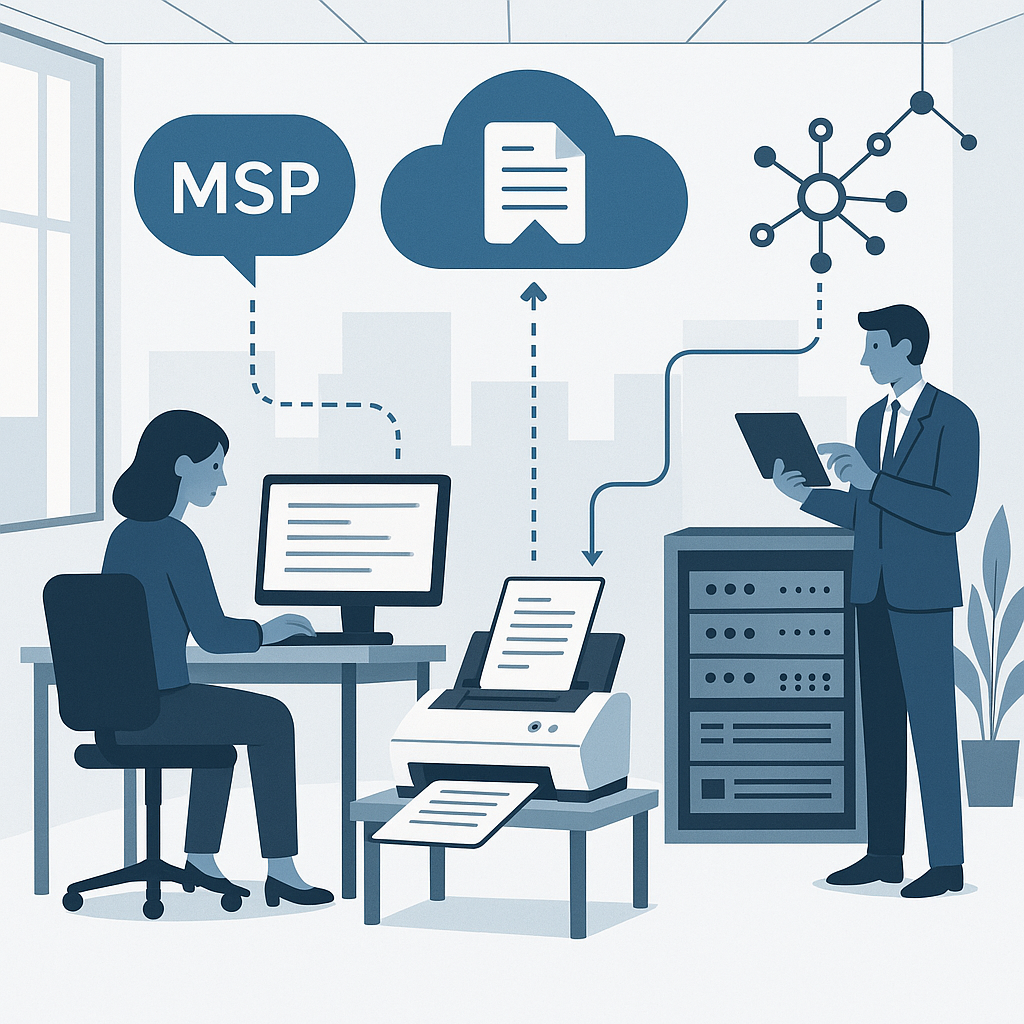
Managed Service Providers can unlock new revenue streams and deliver greater value by integrating data capture solutions into their existing technology portfolios.
The Evolution of MSP Services Beyond Traditional IT Management
The modern MSP landscape has shifted dramatically over the past decade. What began as break-fix support and basic network monitoring has evolved into comprehensive digital infrastructure management. Today's MSPs handle everything from cloud migrations and cybersecurity to compliance monitoring and strategic IT planning.
This evolution hasn't happened by accident. Client expectations have changed. SMBs and mid-market organizations no longer view IT as simply keeping systems running—they expect their technology partners to drive business outcomes. They're looking for advisors who understand their operational challenges and can recommend solutions that improve efficiency, reduce costs, and enable growth.
Data capture represents the next logical step in this progression. As businesses digitize their operations, the bottleneck increasingly isn't infrastructure or connectivity—it's the manual processes that slow down critical workflows. Paper-based forms, email attachments that require manual data entry, and fragmented document management systems create inefficiencies that undermine the digital transformation investments MSPs have already helped their clients make.
For MSPs positioned as trusted advisors, ignoring data capture means leaving money on the table while clients struggle with preventable friction points. The question isn't whether to expand into data capture services, but how to do it strategically.
How Data Capture Aligns With Core MSP Competencies
Data capture in a modern MSP context goes far beyond scanning documents. It encompasses digital intake systems, automated forms processing, intelligent document classification, data extraction from unstructured sources, and workflow automation that routes information to the right systems and people. Essentially, it's about converting information—whether from paper, PDFs, emails, or web forms—into structured, actionable data that integrates with business systems.
This aligns perfectly with what MSPs already do well. You're already managing the endpoints where documents are created and received. You're already securing the networks through which sensitive information flows. You're already maintaining the cloud platforms and business applications where captured data needs to land. You're already the trusted advisor clients turn to when they need to solve operational challenges.
Consider the typical MSP engagement. You've implemented Microsoft 365, configured security protocols, established backup procedures, and perhaps deployed compliance monitoring. When that same client mentions their accounts payable team is drowning in paper invoices, or their HR department spends hours manually entering employee data from forms, you're hearing about a workflow problem—one that sits squarely in your wheelhouse.
Data capture solutions integrate with the infrastructure you've already deployed. They complement your existing security posture by providing audit trails and access controls. They support compliance initiatives by ensuring document retention policies are followed. And they demonstrate your understanding of the complete technology stack, not just the network layer.
MSPs who position data capture as a natural extension of managed workflows—rather than a separate, specialized service—find it easier to introduce and easier to sell. You're not asking clients to trust you with something completely outside your expertise. You're helping them maximize the value of the digital infrastructure you've already built together.
Revenue Opportunities Through Document Management Integration
The business case for MSPs is compelling. Data capture creates multiple revenue streams that align with the recurring revenue model MSPs depend on. Implementation fees provide upfront revenue, while monthly management fees for ongoing support, system monitoring, storage, and user licenses create predictable recurring income.
More importantly, data capture increases client stickiness. Once you've automated a client's accounts payable workflow or integrated document capture into their CRM, you've become embedded in their daily operations in a way that basic infrastructure management never achieves. The switching costs become significantly higher, and the relationship deepens from vendor to strategic partner.
Real-world applications demonstrate the breadth of opportunity. In accounts payable automation, invoices arrive via email or paper, get automatically captured and routed for approval, then flow directly into accounting systems—eliminating manual data entry and accelerating payment cycles. For HR departments, new hire paperwork can be digitally captured, with information automatically extracted and populated into HRIS systems, dramatically reducing onboarding time.
Healthcare practices need compliant document management for patient records, insurance claims, and referrals. Financial services firms require secure capture and retention of client documents with full audit trails. Legal practices manage case files, contracts, and discovery documents. Manufacturing companies track shipping documents, quality certifications, and supplier paperwork. Each vertical presents specific use cases with measurable ROI.
The differentiation advantage matters too. In competitive MSP markets, service offerings often look remarkably similar. Cloud services, security, backup, helpdesk—everyone offers the same core stack. Data capture and workflow automation give you something concrete to differentiate with, especially when tied to specific industry pain points you understand well.
Starting doesn't require massive investment. Many MSPs begin with a single vertical or use case—perhaps invoice processing for professional services firms, or forms automation for organizations with high-volume intake needs. This targeted approach lets you develop expertise, create replicable processes, and build case studies before expanding to additional scenarios.
Leveraging Existing Infrastructure for Seamless Data Capture Deployment
One of the biggest advantages MSPs have when entering the data capture space is that much of the required infrastructure is already in place. Your clients already have multifunction devices that can scan. They already have cloud storage platforms. They already have business applications that need to receive captured data. Your job is orchestrating these components and adding the intelligence layer that makes capture and processing automatic.
Modern data capture solutions are designed to integrate with the technology stacks MSPs already support. They connect to Microsoft 365, Google Workspace, and common line-of-business applications through standard APIs. They can pull documents from network folders, email inboxes, or cloud storage. They work with the security frameworks you've already implemented, supporting single sign-on, role-based access, and encryption requirements.
This means deployment doesn't require rip-and-replace of existing systems. You're adding capability to infrastructure clients have already invested in. The multifunction printer on their network becomes an intelligent capture device. The SharePoint environment you set up becomes the repository for organized, searchable documents. The workflow automation platform you've deployed extends to include document routing.
From a technical management perspective, data capture solutions fit naturally into your existing monitoring and support processes. They generate logs you can track. They have uptime requirements you can SLA. They need updates and patches you can schedule. They're manageable within your PSA and RMM tools just like other applications in your stack.
The key is choosing solutions that align with your technical capabilities and your clients' needs. Look for platforms that offer white-label or co-branding opportunities, allowing you to present data capture as your managed service. Prioritize vendors that provide partner support, implementation assistance, and documentation that helps you scale delivery without becoming dependent on vendor resources for every engagement.
Starting small with pilot implementations lets you prove value quickly. Choose a client with a clear pain point, implement a targeted solution, measure the results, and use that success to refine your approach. Build standardized deployment processes, develop documentation and training materials, and create pricing models that reflect the ongoing value you're delivering.
Building Competitive Advantage With Comprehensive Workflow Solutions
The MSPs winning in today's market aren't those competing on price for commodity services. They're the ones solving complete business problems and demonstrating measurable impact on client operations. Data capture positions you to have exactly those conversations.
When you can walk into a prospect meeting and discuss not just infrastructure and security, but also how you'll eliminate bottlenecks in their invoice processing, accelerate their customer onboarding, or ensure their compliance documentation is audit-ready, you're operating at a different level than competitors who only talk about servers and switches.
This comprehensive approach creates a defensible competitive position. It's relatively easy for another MSP to undercut your pricing on helpdesk support. It's much harder for them to displace you once you've automated mission-critical workflows that run through systems you manage. The client relationship becomes consultative rather than transactional.
The workflow focus also opens doors to different stakeholders within client organizations. Traditional MSP conversations happen with IT managers or operations directors. Data capture gives you reasons to engage with finance leaders frustrated by slow invoice cycles, HR managers drowning in paperwork, and compliance officers worried about document retention. You're expanding your sphere of influence within client organizations.
Long-term, this positions your MSP for the digital transformation conversations that drive significant spending. Organizations pursuing digitization initiatives need partners who understand not just technology, but business processes. Data capture expertise demonstrates that broader understanding and establishes credibility for larger transformation projects.
The market opportunity is substantial. According to industry research, most SMBs and mid-market organizations still rely heavily on manual document processes despite broad cloud adoption. They've moved email to the cloud and migrated files to SharePoint, but they're still printing documents to get signatures, manually typing information from PDFs into business systems, and searching through unorganized network folders to find critical documents. These are problems MSPs can solve.
Getting started doesn't mean becoming a document management specialist overnight. It means recognizing that the workflows your clients struggle with are technology problems—and technology problems are exactly what MSPs solve. Explore partnerships with vendors who provide data capture platforms designed for the channel. Identify one or two use cases that match your client base. Build a repeatable offering. Measure the results. And position your MSP as the partner who delivers complete solutions, not just infrastructure components.
Data capture isn't a departure from your core MSP business. It's the natural evolution of what you're already doing—helping clients work more efficiently, reduce risk, and achieve better business outcomes through smart technology deployment. The infrastructure is already in place. The client relationships already exist. The opportunity is waiting for MSPs ready to expand beyond traditional IT management into comprehensive workflow solutions. Reach out to one our Image Star's Account Executives to learn more.